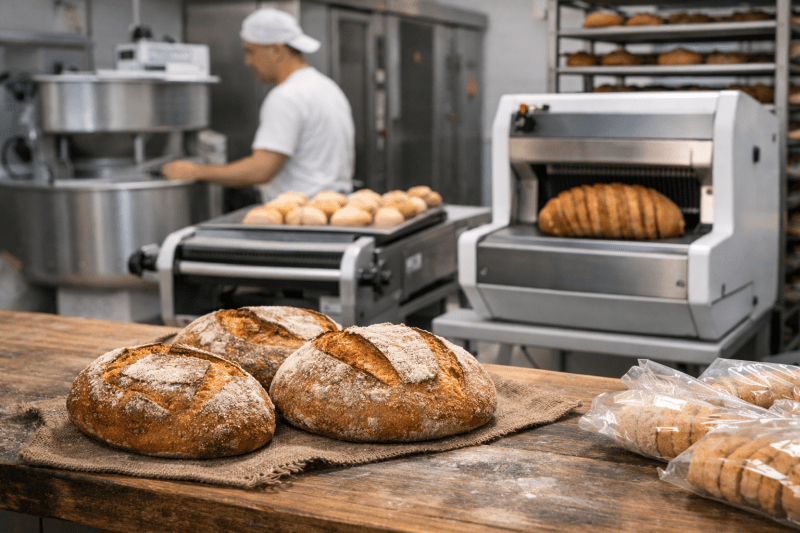
Sourdough Bread in Industrial Production – Technology and Quality
Sourdough Bread is gaining renewed attention among modern consumers. Customers increasingly seek authentic flavour and natural fermentation. Therefore, bakeries invest in advanced technology. At the same time, they want to preserve traditional character. Moreover, the market demands consistent quality and repeatability. As a result, industrial production must support craftsmanship rather than replace it. This is where properly selected bakery equipment plays a crucial role.
In practice, Sourdough Bread requires precise fermentation control. The entire process depends on time and temperature stability. For that reason, automation cannot be accidental. Additionally, the production line must support the natural development of sourdough cultures. Thanks to this approach, bakeries maintain high quality while increasing production scale. Proper slicing also influences the final perception of the product.
Technology Supporting Traditional Baking
A modern bakery combines tradition with automation. First, it prepares a stable sourdough starter. Then, it controls dough hydration and mixing intensity. Next, it ensures proper dough handling. As a result, crumb structure remains uniform and elastic. However, excessive mechanical impact may damage texture. Therefore, the production line must be carefully selected.
Sourdough Bread – Fermentation Control and Consistency
Fermentation determines aroma and structure. Consequently, fermentation chambers must operate under stable conditions. Since each batch may vary in humidity, control becomes essential. At the same time, operators require intuitive control systems. In this way, Sourdough Bread maintains consistent parameters across batches. Furthermore, bakeries reduce raw material losses.
Efficiency Without Compromising Quality
Production scale continues to grow. Nevertheless, customers expect authentic flavour. Therefore, technology should assist bakers instead of replacing them. Automatic dough dividing accelerates workflow. Yet, the dough structure must remain intact. Proper forming techniques preserve crumb porosity. Thanks to this balance, Sourdough Bread retains its artisanal appearance and taste.
Sourdough Bread – The Importance of Slicing in Bread Sales
Finished loaves must be presented properly. Since many customers prefer sliced bread, convenience matters. This is where a professional bread cutter machine becomes essential. Such equipment guarantees even slice thickness. Moreover, it improves workplace safety and operational speed.
Perfectly sliced Sourdough Bread enhances product presentation. Uneven slices may discourage buyers. Therefore, investing in reliable equipment supports retail performance. Additionally, faster slicing shortens customer service time. As a result, store efficiency increases.
Automation in Slicing Bread and Rolls
Many bakeries also offer portioned rolls. In this case, a professional bread slicer ensures precise cutting. Although primarily designed for loaves, advanced machines handle different bakery products. Consequently, the sales offer becomes more versatile.
Blade precision significantly affects slice quality. Since Sourdough Bread often has a firm crust, cutting components must be durable. Therefore, manufacturers use high-quality steel. At the same time, machine construction should allow easy cleaning. This guarantees hygiene and long-term reliability.
If you want to explore more practical solutions, visit our bakery blog. There you will find implementation examples and expert insights. Additionally, these materials help bakery owners plan future investments.
You can also follow our projects on YouTube. We regularly present real production installations. This allows you to evaluate machine performance in real conditions.
Cost Optimisation in Sourdough Production
Sourdough production typically requires more time. However, proper organisation shortens production cycles. Therefore, batch planning becomes crucial. Furthermore, automated dosing systems stabilise the process. As a result, Sourdough Bread can be produced efficiently without sacrificing quality.
Energy costs continue to rise. For that reason, energy-efficient ovens are becoming standard. Since sourdough baking may require longer time, optimisation is vital. Meanwhile, modern control systems regulate steam precisely. This ensures a crispy and evenly baked crust.
The packaging stage also plays an important role. Although many customers choose unpacked bread, others prefer packaged portions. Therefore, integrating slicing and packaging lines increases operational efficiency. In consequence, Sourdough Bread reaches customers faster while maintaining freshness.
How to Choose Machinery for Sourdough Production
Selecting technology should begin with market analysis. First, determine production scale. Then, evaluate available workforce. Next, define the investment budget. This structured approach supports rational decision-making.
If your primary product is loaf bread, investing in a reliable bread cutter machine improves workflow and customer comfort. At the same time, expanding product variety may justify additional slicing solutions.
A properly designed production line supports long-term growth. Since the bakery market evolves dynamically, flexibility becomes essential. Nevertheless, quality remains the foundation. Therefore, Sourdough Bread should be treated as a strategic product category.
In conclusion, Sourdough Bread can be successfully produced on an industrial scale. However, technology must enhance tradition rather than replace it. Proper equipment selection ensures both efficiency and authentic quality. Consequently, bakeries build competitive advantage and strengthen their brand position.