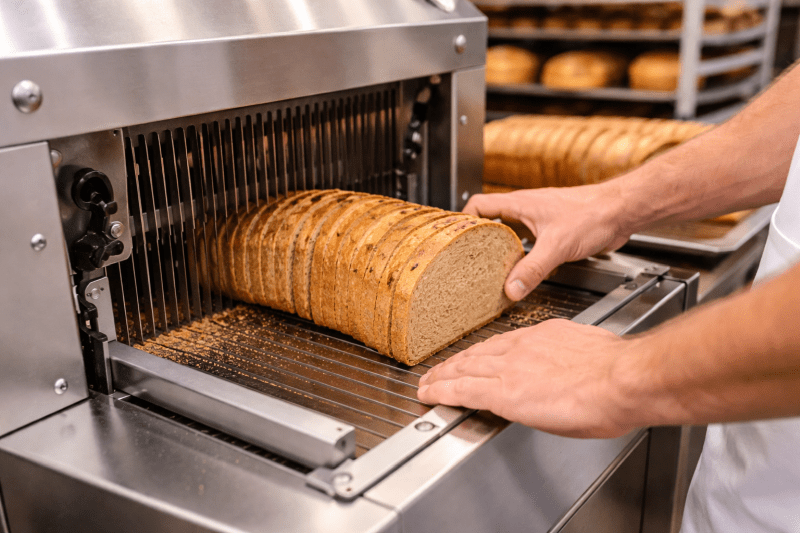
How to prevent crumbling bread during slicing in a bakery?
Crumbling bread is a common issue faced by bakery owners. The problem directly affects product appearance and sales performance. Moreover, excessive crumbling generates raw material losses and weakens brand perception. Therefore, understanding the causes and implementing proper technological solutions is essential.
In practice, slicing quality depends both on baking parameters and on the machine used. Properly selected Bread cutter systems reduce waste and improve workflow efficiency. At the same time, correct blade and pressure adjustment stabilizes the loaf structure. Furthermore, bread type, moisture level, and cooling time play a crucial role.
Main causes of bread crumbling
First of all, crumbling usually results from several combined factors. Therefore, process analysis should include both baking and slicing stages.
1. Incorrect bread moisture level
Overly dry crumb increases brittleness of slices. Meanwhile, excessively moist bread sticks to blades. As a result, the structure becomes damaged. For this reason, controlling baking and cooling time is critical. Proper moisture stabilization improves crumb elasticity.
2. Dull or improperly selected blades
Blades that are not regularly maintained lose sharpness. Consequently, instead of cutting cleanly, they tear the structure. Importantly, different bread types require different slicing parameters. Rye bread behaves differently than wheat bread. Therefore, regular servicing and blade inspection remain essential.
3. Incorrect pressure settings
Excessive pressure deforms the loaf before slicing. On the other hand, insufficient pressure causes vibration. As a result, slices appear uneven. Professional Bread cutter machines allow precise parameter adjustment. Thanks to this, operators can match settings to specific products.
How to reduce crumbling bread with modern technology?
Crumbling bread in modern bakeries can be minimized through proper equipment selection and process optimization. Investing in automated systems significantly improves slicing consistency.
Advanced solutions in slicing machines
Modern machines include vibration reduction systems. Additionally, they use stabilizing frames that secure the loaf. As a result, slicing becomes smooth and precise. Manufacturers also implement energy-efficient drives. You can explore more technical insights on our bakery blog.
It is also worth considering specialized equipment such as a Bread slicer for bread. This type of solution ensures uniform cuts without product deformation. At the same time, it enhances product presentation at the point of sale. Importantly, such equipment works efficiently both in bakeries and retail stores.
Automation and repeatability
Crumbling bread during high-volume production can be significantly reduced through automation. Automated systems eliminate operator errors. Furthermore, they ensure consistent slice thickness. As a result, customers receive visually attractive and properly packaged products. Additionally, reduced waste translates into higher margins.
In practice, properly selected Bread cutter equipment shortens service time. Simultaneously, it improves staff ergonomics. Therefore, the investment often delivers a fast return.
Bread Crumbling – Technical parameters that matter
Slice thickness
Thickness adjustment directly affects product durability. Slices that are too thin dry out faster. Meanwhile, overly thick slices may break. Therefore, precision adjustment is essential. Reducing Crumbling bread without this feature becomes far more difficult.
Blade lubrication system
Professional machines include systems that reduce sticking. Consequently, slicing remains clean. Moreover, maintenance becomes easier. As a result, the machine operates longer without downtime.
Structural stability
A heavy-duty frame reduces vibration. Proper construction enhances cutting precision. Therefore, choosing proven industrial solutions is recommended. On our YouTube channel, we present real-life demonstrations of our machines in operation.
Bread Crumbling – Organizing the slicing process in a bakery
Crumbling bread can also be reduced through better workflow organization. First, define the minimum cooling time. Next, train staff to adjust parameters correctly. Additionally, introduce a regular maintenance schedule.
A well-planned process reduces waste. At the same time, it improves customer service quality. Consequently, bakeries gain competitive advantage. Moreover, clean and even slices enhance shelf presentation.
In summary, minimizing Crumbling bread depends on three pillars: technology, machine parameters, and process organization. By investing in modern Bread cutter solutions and proper adjustments, bakeries reduce waste and elevate product standards. Meanwhile, consistent servicing and operator training ensure long-term efficiency.